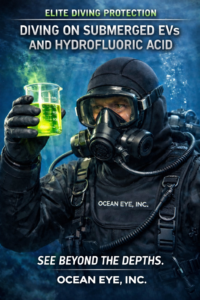
 As electric vehicles become more common, they are creating new questions for salvage personnel.
One of the biggest questions is this: if an electric vehicle is submerged, is hydrofluoric acid a concern?
The answer is yes, it can be. Under certain lithium-ion battery failure conditions, hydrofluoric acid, commonly referred to as HF, may be present. That gets attention quickly, and for good reason. HF is not something to take lightly.
That said, it is important to separate real risk from unnecessary panic.
Why sulfuric acid testing matters
When manufacturers evaluate materials for chemical resistance, they typically test against the most aggressive chemical in a given class. The goal is to establish a meaningful benchmark under tough conditions.
Understanding hydrofluoric acid
Hydrofluoric acid is a little different than many people expect.
Technically, HF is classified as a weak acid in water. But that description can be misleading. Weak does not mean safe. In practical terms, HF is extremely hazardous and highly corrosive.
What we commonly call hydrofluoric acid is really hydrogen fluoride dissolved in water. From a classic acid-strength standpoint, it is significantly less acidic than sulfuric acid. Based on that comparison alone, expected breakthrough performance in diluted HF solutions would be less aggressive than the 50% sulfuric acid condition that already exceeded 480 minutes.
That is encouraging from a suit-material perspective.
But HF has to be treated with a very high level of respect because its danger is not just about acidity.
Why HF is especially dangerous
The real concern with hydrofluoric acid is what it can do biologically.
HF can penetrate tissue deeply.
Fluoride ions can bind calcium and magnesium in the body.
Burns may not be immediately painful.
That last point is especially important. A person may not realize the seriousness of exposure right away, even though injury is occurring.
So while the suit material may hold up very well, that does not make HF a minor hazard. It simply means material resistance looks favorable based on the available testing.
How it behaves in the water
Another part of the equation is environmental behavior.
A 49% HF solution has a specific gravity of approximately 1.15, which means it is heavier than water. In a diluted scenario, it may tend to settle lower in the water column, right where a diver could be working.
That is very different from many petroleum products, which are lighter than water and typically float at the surface.
Why dilution matters
To put dilution into perspective, a standard 20′ x 40′ swimming pool contains approximately 35,000 gallons of water. If 100 gallons of acid were introduced into that volume and evenly distributed, the resulting concentration would be roughly 0.28%.
That is a dramatic reduction.
In open water, dilution would generally be even greater, lowering concentrations further. That is one reason broad open-water exposure is typically less concerning than a confined environment.
Where the bigger concern may be
One area that deserves closer attention is the interior cabin of a submerged vehicle.
Inside the passenger compartment or other enclosed spaces, limited water exchange could allow temporarily elevated localized concentrations before full dilution occurs. That kind of environment is very different from working on the exterior of a vehicle in open water.
This is where scene assessment, exposure potential, and PPE selection become especially important.
What is a Solution
For acids, Whites used sulfuric acid for their material evaluation.
In this case, the drysuit material was tested using a 50% sulfuric acid solution. That is a very aggressive test condition, and far more severe than what we would normally expect a diver to encounter underwater in the field. Under that test, the material achieved a breakthrough time greater than 480 minutes.
That is a strong result and gives us a useful reference point.
Based on available research regarding lithium-ion battery incidents, the potential presence of hydrofluoric acid appears to have little effect on the Whites Hazmat family of drysuits from a material-resistance standpoint. That is an important part of the discussion, but it is not the whole story.
The bottom line
Here is the practical takeaway.
Based on sulfuric acid testing, the Whites Hazmat drysuit material appears to offer strong chemical resistance, and diluted hydrofluoric acid exposure would be expected to be less aggressive on the suit material than the 50% sulfuric acid test condition.
That is the good news.
The caution is that hydrofluoric acid remains a serious hazard because of its unique toxic effects on the body and because localized concentrations may be more significant in confined submerged spaces.
So the conversation should not stop at, “Will the suit hold up?”
The better question is: what is the actual exposure environment, where is the diver working, and what other protective measures need to be considered?
As with most things in commercial diving, context matters.