To understand modern drysuits, you have to start with diving helmets.
The earliest helmets—often referred to as “smoke helmets”—were developed in England around 1824 by Charles and John Deane. These early designs had two major flaws: they flooded when the diver leaned forward, and there was no effective way for air to exhaust from the helmet.
The solution was simple but important. A short jacket was attached to the helmet, allowing air to exhaust from the bottom of the garment. This not only solved the exhaust problem, it also reduced flooding. With that change, the first true diver’s dress was born.
By the 1830s, Augustus Siebe refined the helmet design for underwater use, and shortly after, George Edwards introduced what we would recognize as the first full diver’s dress. Edwards is often credited—or blamed, depending on your perspective—for the invention of the first drysuit.
Since then, drysuits have evolved dramatically in both materials and construction. Designs vary, and there’s no single “perfect” suit. Every drysuit is a compromise between protection, flexibility, serviceability, and mission requirements.
Common Drysuit Types (and Their Tradeoffs)
Today’s commercial drysuits generally fall into three main categories. Each has strengths and weaknesses, and the right choice depends on how and where you dive.
Trilaminate
Trilaminate suits are essentially a modern re-imagining of early diver’s dress concepts, using lightweight synthetic layers to create a waterproof barrier. They’re flexible and comfortable, but offer very little inherent thermal protection and can offer (such as the Whites HAZMAT) chemical resistance depending on the type of synthetic material the suit is made with.
Crushed Neoprene
Crushed neoprene suits are popular for good reason. They provide excellent native thermal protection and are relatively more flexible. More flexible than Vulcanized rubber but less than the typical Trilaminate. The downside is reduced chemical resistance, limited field serviceability, and you can’t shed the bulk to vary the warmth as much as other suits (meaning, perhaps not the best choice for warm water).

Vulcanized Rubber
Vulcanized rubber suits have become a go-to option for commercial, military, and public safety divers. While they don’t offer much native insulation, they are highly durable, chemically resistant (second only to butyl rubber), more flexible than butyl suits, and—critically—field serviceable.
Seal Choices: Latex vs. Neoprene
One of the most common questions I hear is about seal preference.
Latex seals are flexible, relatively inexpensive, and easy to replace. Their downside is durability—they’re more prone to accidental damage and dry rot over time.
Neoprene seals tend to last longer and are more resistant to tearing, but they’re less flexible and harder to replace in the field.
If you’re diving with a helmet-mounted neck dam, the decision is often made for you. Latex neck seals are commonly used underneath the dam, and when paired with dry gloves and a yoke system, the system becomes environmentally sealed. At that point, seal choice becomes less about comfort and more about compatibility with the overall system.
Like most gear decisions, seal selection comes down to mission, environment, and personal preference.
Drysuits and Contaminated Water Diving
If you’re diving in contaminated water, material selection matters—period.
There is excellent reference material available from Trelleborg Viking, including their guide Diving in Contaminated Water and chemical permeation test data for various suit materials. While no chart can cover every contaminant a diver might encounter, this data provides a solid baseline for comparing suit performance and service life in hazardous environments.
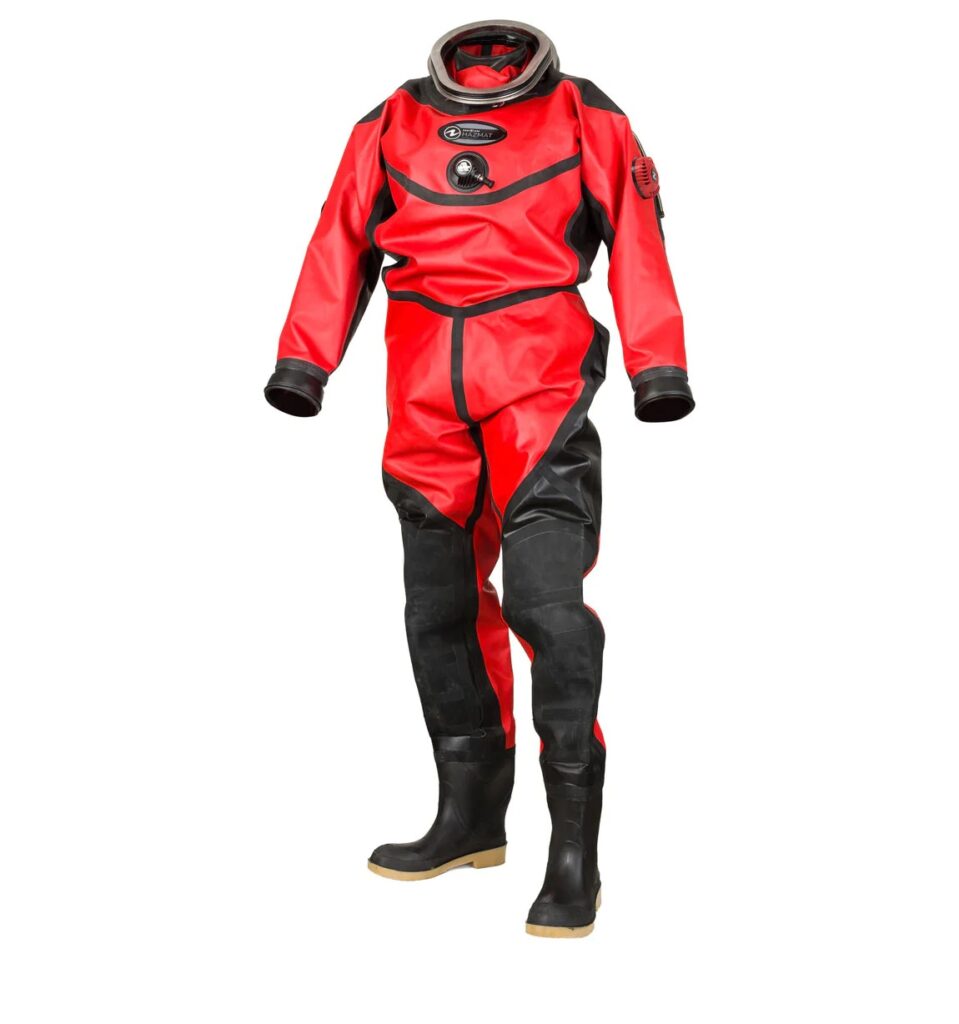
Whites also have a contaminated water drysuit called (wait for it) the HAZMAT. What is unique to this suit is the availability of a yoke system in which you can change the neck seal in the field. This is a HUGE advantage when it comes to productivity and keeping the project moving forward.
When the water is fouled, there’s no margin for guesswork. The suit either protects you—or it doesn’t.
Basic Drysuit Maintenance (Before and After Every Dive)
Every drysuit, regardless of material, needs regular inspection and care.
At a minimum:
- Rinse the suit thoroughly with fresh water after every dive
- Allow it to dry completely before storage
- Keep it out of direct sunlight whenever possible
Sunlight, chemical exposure, and improper storage all shorten a suit’s lifespan.
Before and after every dive, visually inspect the suit for cuts, abrasions, seam damage, and material degradation. A small defect might only be uncomfortable in clean water—but in contaminated conditions, it can be life-threatening.
Watch for Dry Rot
Latex seals are especially susceptible to dry rot. Early signs include fine surface cracking, which will eventually lead to complete failure. UV exposure and chemical contact accelerate this process significantly.
Finding and Fixing Leaks in the Field
If you’re getting wet and don’t know why, there are a couple of practical ways to track down a leak:
- Bubble Test – Don the suit, lightly pressurize it, and submerge in clean water while someone looks for escaping bubbles.
- Soapy Water Test – Pressurize the suit and spray or brush soapy water over the exterior, watching for bubbles.
How you fix the problem depends entirely on the suit material.
Field-Replaceable Seals and Repairs
Whenever possible, I recommend drysuits with field-replaceable seals.
Systems like DUI’s ZipSeals or ring-based systems from Whites allow seals to be changed in minutes instead of hours. Some ring systems also integrate seamlessly with dry gloves, giving you flexibility without additional modifications.
Minor fabric damage can often be handled with manufacturer-supplied patch kits. Latex seals, however, typically require replacement rather than repair.
Any repair—field or otherwise—starts with a clean, dry surface and strict adherence to manufacturer’s instructions. If the repair is beyond your comfort level, or the suit is used in hazardous environments, send it to a factory-trained repair facility. The cost of professional repair is insignificant compared to the cost of exposure.
Final Thoughts
A quality drysuit will give you years of reliable service—if you take care of it.
Like any piece of life-support equipment, neglect shortens its lifespan and increases risk. When in doubt, ask questions. Call the manufacturer. Call a repair facility. Talk to someone who dives the same environments you do.
Safety isn’t optional.